
Cannabis Mold Resistant Strains: Bud Size, Spacing & Outdoor Genetics
If you’re growing outdoors in the Pacific Northwest or another region where the end of the season brings rain, cool temperatures, and prolonged humidity, I recommend paying close attention to flower structure and plant architecture when choosing your genetics.
Over the years of growing and breeding in Oregon, I’ve found that some of my lines naturally produce the characteristics I look for in a wet-climate outdoor plant: thinner flowers, more open internodal spacing, and better airflow through the flowering sites.
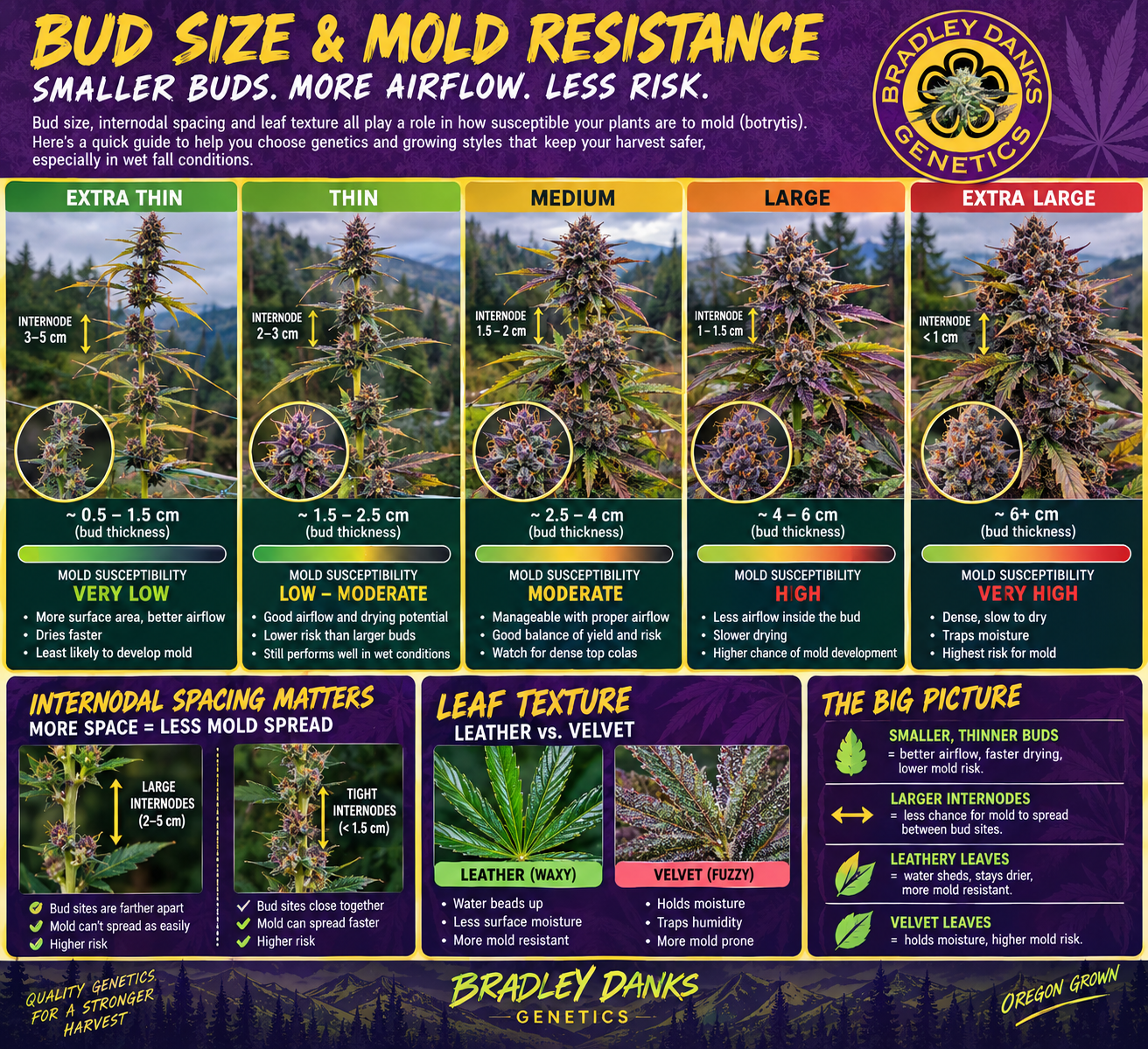
Here are some of the Bradley Danks Genetics lines that fit different points on the bud-size and structure scale shown in the chart above.
Extra Thin Buds + Large Internodal Spacing
Pink Drizzle
Pink Runtz × Candy Rain
Pink Drizzle is one of the lines I would put toward the extra-thin flower / high-airflow end of the spectrum.
The plants I’ve selected tend to produce relatively thin flowers with large spacing between the flowering sites. That open structure is particularly useful when growing outdoors in a wet fall climate because there is less dense flower material packed together and more room for air to move through the plant.
Platinum Pink Runtz
Pink Runtz × Platinum Jager
Platinum Pink Runtz is another line that falls into the extra-thin flower category, with larger internodal spacing.
For growers who are primarily concerned with getting through a wet outdoor finish, this type of structure is something I specifically look for when making selections.
Pink Sauce
Pink Runtz × Jagerschnitzel bx3
Pink Sauce combines Pink Runtz with Jagerschnitzel bx3 and is another example of the thin, open flower structure I’m talking about.
The combination of thinner flowers and larger spacing between bud sites gives the plant more opportunity to move air through the flowering structure rather than creating one continuous mass of dense flowers.
Thin Buds + Large Internodal Spacing
Jagerschnitzel
Jagerschnitzel is one of my favorite examples of the type of outdoor structure I’m talking about.
The flowers tend to be thin and elongated rather than extremely dense, while the plants can have large internodal spacing and a more open, leggy structure.
That architecture was actually part of what I wanted when developing the line for the cool, wet Pacific Northwest.
It’s not about producing the biggest possible cola.
It’s about producing flowers that can finish well in a challenging environment.
Jager Punch
Purple Punch × Jagerschnitzel F1
Jager Punch carries that Jagerschnitzel influence into another combination.
It generally falls into the thin-bud / large-internode category on the chart.
For an outdoor grower dealing with wet fall conditions, this is the type of structure I would be looking at when trying to balance flower quality with airflow and drying characteristics.
Jagerschnitzel and Jager Punch are both currently listed in the Bradley Danks Genetics feminized collection.
Medium Buds + Medium Internodal Spacing
Jager Cookiez
Oreoz × Jagermeister
Jager Cookiez moves toward the middle of the chart.
Instead of the very thin flowers and wide spacing found in some of the Jagerschnitzel and Pink Runtz crosses, Jager Cookiez generally produces medium-sized flowers with medium internodal spacing.
That makes it an interesting middle ground for growers who don’t necessarily want extremely thin outdoor flowers but still want a plant with reasonable spacing and airflow.
Larger Buds
Cherry Jager
Lemon Cherry Gelato × Jagermeister
Cherry Jager moves farther toward the large-bud side of the spectrum.
The flowers can become larger and more substantial, so I would put this one closer to the “large” category on the chart.
That doesn’t automatically mean a plant is unsuitable for outdoor growing. It simply means that as flower density and size increase, site selection, canopy management, airflow, and weather conditions become increasingly important.
Rainbow Jager
RS11 × Jagermeister
Rainbow Jager is another Jager cross that can produce larger flowers than the thin-bud Jager lines.
Again, this is where the other characteristics of the plant become particularly important. A large flower can still perform well outdoors when the plant has good structure and the grower is able to keep the canopy open and monitor the flowers during wet weather.
Why I Don’t Offer an “Extra Large Bud” Outdoor Category
You may notice something interesting about the chart:
I don’t currently have a Bradley Danks outdoor recommendation in the Extra Large category.
That’s intentional.
In my climate, I don’t consider extremely large, dense flowers to be an ideal target for outdoor breeding.
The bigger and denser the flower becomes, the more difficult it can be for moisture to escape from the interior during prolonged wet weather.
So rather than breeding specifically for the biggest possible outdoor colas, I’ve chosen to put more emphasis on flower structure, spacing, airflow, finishing time, and overall plant architecture.
I’d rather harvest a slightly smaller flower that makes it through a wet October than grow a massive cola that looks incredible until Botrytis gets established in the center.
That’s a major part of my breeding philosophy.
My Approach to Outdoor Breeding
Living and growing in Oregon has heavily influenced the way I select plants.
When you’re growing somewhere with a dry September, you can get away with structures that may be much more difficult to manage in the Pacific Northwest.
But when you’re dealing with rain, fog, heavy dew and high humidity during the final weeks of flowering, plant architecture becomes extremely important.
That’s why I look at things like:
Bud thickness
Internodal spacing
Flower density
Leaf texture
Airflow through the plant
Flowering time
How quickly the plant dries after rain
How the plant performs late into the season
The goal isn’t simply to breed the biggest buds.
The goal is to breed plants that can produce excellent cannabis and actually finish in the environment they’re intended for.
A Quick Guide to My Outdoor-Structure Recommendations
| Bud structure | Internodal spacing | Bradley Danks examples |
|---|---|---|
| Extra Thin | Large | Pink Drizzle, Platinum Pink Runtz, Pink Sauce |
| Thin | Large | Jagerschnitzel, Jager Punch, Schnitzle Meister, Frost Drops, Noize Candy, Platinum Jager, Multi Platinum, Donny Deluxe, DiGiorno |
| Medium | Medium | Jager Cookiez, Candy Rain, Frosted Face, Chrome Slaps |
| Large | Medium / variable | Cherry Jager, Rainbow Jager |
| Extra Large | — | Not currently offered as an outdoor-focused selection |
The strains listed above are available through the Bradley Danks Genetics collection, with the current shop listing these crosses and their parentage.
One important note
These classifications are my observations from growing and selecting these genetics, not a guarantee that a particular strain will never develop Botrytis. Weather, humidity, rainfall, plant spacing, canopy density, insects, physical damage, and harvest timing can all affect mold development.
The point is to give outdoor growers another way to think about genetic selection.
If you know you’re growing in an environment where October can be cold and wet, selecting a plant with smaller flowers, larger internodal spacing, good airflow, and appropriate leaf structure can be a much better starting point than simply choosing the variety with the biggest flowers.
Breed for your environment.
That’s what I’ve been doing with Bradley Danks Genetics.